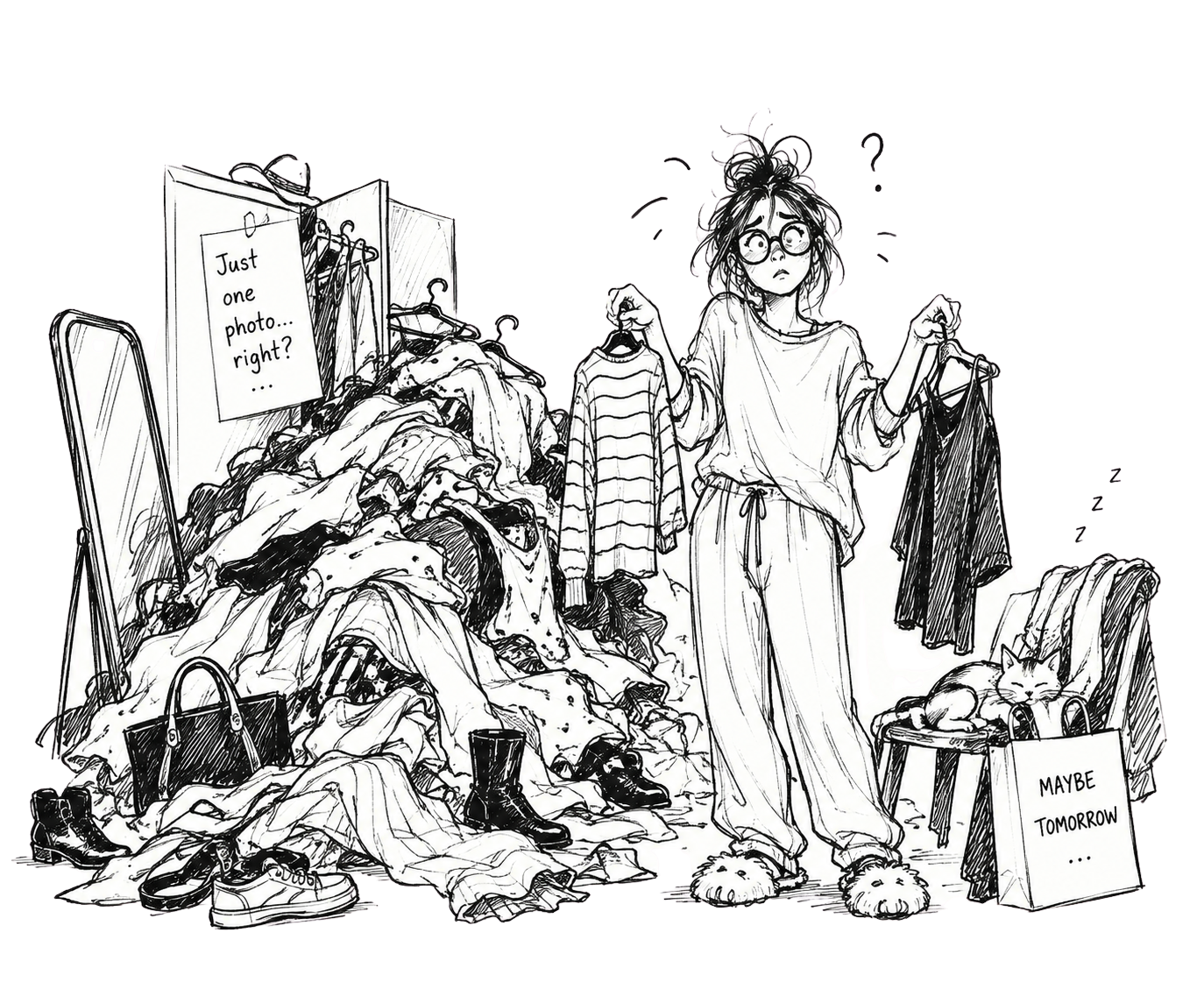
You find an outfit you like, take a few pictures, and suddenly it looks completely different from what you expected. The shirt seems too loose. The pattern is distracting. The jacket that looked great in the mirror makes the whole photo feel a little too formal. So you change clothes, take another batch, and somehow end up with twenty pictures and no idea what to wear.
Choosing clothes for photos can get surprisingly complicated because you're trying to solve two different problems at once: finding something you like wearing and finding something that works in a photograph. Those goals usually overlap, but not always.
The good news is that you don't need a special photo wardrobe. A few practical checks can help you choose an outfit that looks good in the frame, feels comfortable in real life, and still looks like something you would actually wear.
Start with clothes you already enjoy wearing
Before looking for a new outfit, think about the clothes you reach for when you're not taking pictures. Maybe it's a particular pair of jeans, a simple dress, a shirt you like, or a jacket that makes an ordinary outfit feel more like you.
These are useful starting points because you already know how they feel and how you move in them. You're less likely to spend the entire photo session pulling at the sleeves or wondering whether the neckline is sitting correctly.
Try building an outfit around one familiar piece instead of choosing everything from scratch. If you like wearing straight-leg jeans, start there. If you usually feel comfortable in dresses, choose one you can walk and sit in without constantly adjusting it. Add a second piece only if it makes sense for the weather or the setting.
Here's a useful question to ask yourself: would you wear this outfit if nobody were taking your picture? Maybe you genuinely want to dress up for the occasion, and that's perfectly fine. But if you're wearing something only because you think photographs require a completely different version of you, you may be making the process harder than it needs to be.
Choose the outfit for the place and activity
The same clothes can feel completely different depending on where you're taking the photo. An outfit that works beautifully for a café may look out of place on a beach walk. Something comfortable for exploring a city might feel too casual for a more formal evening.
Instead of starting with a style category like “elegant” or “Instagram-worthy,” picture the actual situation. If you're meeting a friend for coffee, start with something you'd genuinely wear to meet them. If you're walking around a city, think about the shoes and layers you'd normally need for that walk. If you're taking pictures at home, there's no reason to dress as though you're about to attend an event.
This doesn't mean you have to dress according to strict rules for every location. A dress can work in a café, a park, or on a city street. Jeans can work in all three, too. The point is to notice whether the outfit belongs in the situation and whether you can comfortably do what you're actually there to do.
If you're planning several different scenes, you don't necessarily need several completely different outfits. Sometimes changing a layer or an accessory is enough to make the same basic clothes feel appropriate for another setting.
Use color to make the outfit easier to see
You don't need to find the perfect color palette before taking a picture. But color can affect how clearly your clothes stand out from the background.
Imagine wearing a pale beige outfit against a very light wall. The clothes may blend into the background, especially if the light is flat. A dark outfit against a dark wall can create a similar problem. Neither combination is automatically bad, but the overall image may lose some visual separation.
The easiest way to check is to take one test photo in the actual place where you plan to shoot. If your outfit disappears into the background, try moving to a different spot before changing clothes. A few steps toward a darker wall, a patch of greenery, or a different part of the room may be all you need.
If the background is already visually busy, a simpler outfit can make the image easier to read. A plain top with jeans, for example, may work well against a café full of signs, furniture, and people. You don't have to avoid color. Just notice whether your clothes and the background are competing for attention.
When you check the test photo, look at the whole frame rather than zooming straight into your face. Can you distinguish your outfit from the background? Is one color pulling all the attention? If something feels crowded, change one element first instead of replacing the entire outfit.
Patterns are fine. Just check how they look on camera.
Patterns can look great in photographs, but some are more distracting than others. A large, bold print may become the main thing you notice in the image. Very fine, repetitive patterns can also render unpredictably on some cameras or screens, sometimes creating a strange visual effect.
If you're unsure about a patterned piece, take a quick test photo from the distance you plan to use. Don't judge it only by looking at the fabric up close. A pattern that seems subtle in the mirror may become much more noticeable in the finished frame.
If the print is taking over the picture, try pairing it with simpler pieces or moving to a less complicated background. If narrow stripes or tiny checks look strange in the photo, try a solid color or a larger, less repetitive pattern. And if you love the print and it looks good in the test shot, keep it. There's no reason to avoid patterns automatically.
Check how the outfit looks when you sit down
This is one of the easiest things to forget when choosing clothes for photos. You try on an outfit while standing in front of a mirror, decide it looks good, and then take pictures sitting at a café table or on a park bench.
Suddenly the shirt bunches up, the skirt sits differently, the trousers crease in an unexpected place, or the jacket pulls across the shoulders. Clothes naturally change when you move, so this isn't automatically a problem. But if the outfit becomes uncomfortable or keeps distracting you, it's worth checking before the photo session.
Try sitting down as you would in the actual setting. Then stand up, walk a few steps, turn, and reach forward as you might when picking up a cup or adjusting a bag. Notice whether you keep pulling at the fabric, fixing the neckline, or trying to hide a part of the outfit.
If you do, try a different size, a different layer, or a piece that allows more movement. You don't need to eliminate every crease. You're looking for clothes that behave reasonably well during the activity you're photographing.
Layers can give one outfit more than one look
A jacket, cardigan, overshirt, or light layer can change the feel of an outfit without requiring a complete wardrobe change.
Jeans and a simple top can look casual on their own. Add a jacket and the outfit may feel more structured. Remove it indoors, and you have a different look from the same basic pieces. This can be useful if you're taking pictures in several places or want some variety without bringing an entire suitcase of clothes.
The practical trick is to make sure the outfit works both with the layer and without it. If the whole look only feels right when the jacket is covering something you're uncomfortable with, you may end up spending the session worrying about whether it stays in place.
Choose layers you'd genuinely wear, and check how they sit when you're standing, sitting, and moving. If the extra piece keeps slipping or needs constant adjustment, it might not be worth including.
Accessories should belong in the situation
A bag, watch, pair of sunglasses, necklace, or favorite earrings can add a personal detail to a photo. They can also help an outfit feel complete without requiring more clothes.
But accessories are most useful when they belong in the situation. If you're going for a walk, bring the bag you would normally carry. If you're sitting outside on a sunny day, sunglasses may make sense. If you rarely wear jewelry, you don't need to add several pieces just because you're taking pictures.
There's also a practical consideration: some accessories need attention. A bag strap may keep slipping, a necklace may twist, or sunglasses may hide your eyes in a photo where you want your face to be clearly visible.
Before taking lots of pictures, check whether the accessory is doing what you want. If it keeps becoming a distraction, remove it and take another test shot. You don't have to keep something in the frame just because you brought it along.
Don't buy something just because it looks good in a photo
A new outfit can be exciting, especially if you're planning a trip, updating your dating profile, or creating content for social media. But buying clothes specifically for a photo can create a strange kind of pressure: now the outfit has to justify itself by producing a great picture.
If you already have something that works, you may not need to buy anything. If you do want something new, think about whether you'll wear it again. Can you combine it with clothes you already own? Does it fit the places you actually go? Is it comfortable enough to wear for more than a few minutes?
A useful purchase should work outside the photograph too. Otherwise, you may end up with a very expensive outfit that lives in your closet waiting for its next brief appearance.
Take one test photo before changing everything
It's tempting to keep adjusting your outfit before you've even seen how it looks in the actual setting. You change the top, switch the shoes, add a jacket, remove the jacket, and somehow the original outfit starts looking pretty good again.
Instead, take one test photo first. Use the camera distance and background you actually plan to use. Look at the full image and identify the specific thing that isn't working. Maybe the colors blend together. Maybe the pattern is distracting. Maybe the outfit looks great standing up but feels awkward when you're sitting.
Then make one adjustment and take another picture. Move to a different background before replacing your clothes. Remove an accessory before changing the entire outfit. Try a layer before deciding you need something new.
Small changes are easier to evaluate because you can see what actually improved the picture. If you change everything at once, it's much harder to know what made the difference.
You can look put-together without dressing for a photoshoot
It's easy to assume that good photos require a special outfit, a carefully coordinated palette, and clothes that look impressive from every angle. Sometimes dressing up is exactly what you want. But for everyday photographs, the most useful outfit is often one that fits the activity and lets you focus on what you're doing.
Start with clothes you already like. Check how they look in the actual setting. Make sure you can move comfortably, and use a test photo to catch anything that doesn't work as expected.
You can always experiment with a different color, a new layer, or an accessory later. You don't need to solve your entire wardrobe before taking a few pictures.
Choose clothes that work in the photograph and in the life happening around it. That's a much easier standard to live with than trying to dress for every possible camera angle.