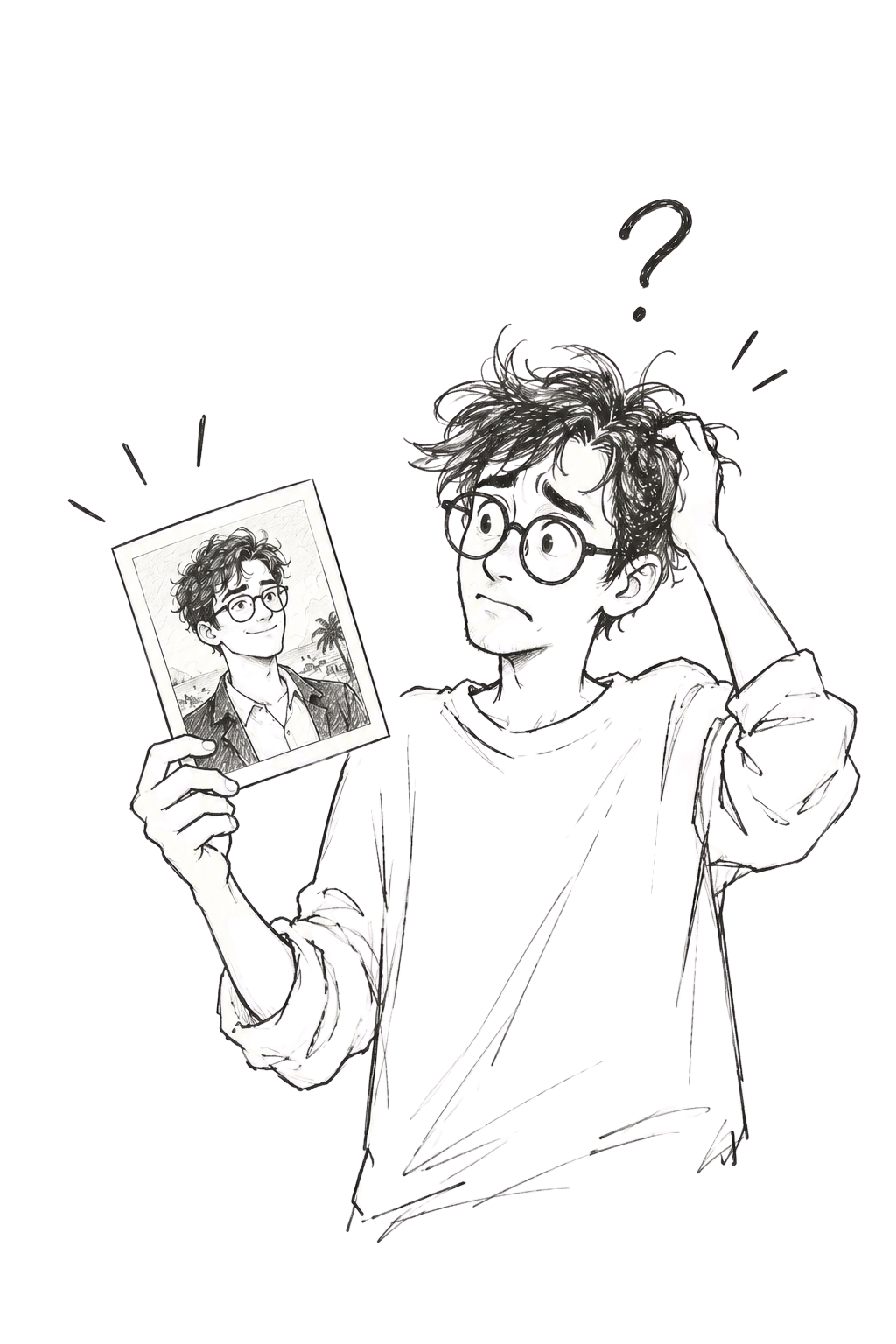
You know that slightly strange feeling when you look at a photo and think, “Yes, that's me. Technically.” The face is yours, the clothes are yours, and you were actually there. Nobody accidentally photographed your cousin. And yet, something feels off.
It's not necessarily a bad photo. It might even be one of the better ones. Your hair looks good, the lighting is nice, and you don't hate your expression. But if someone showed it to you without telling you when it was taken, you might not immediately think, That looks like me.
This happens more often than people realize. A photograph can accurately show what you look like without capturing much of what makes you feel familiar.
A photo can be accurate and still feel wrong
We usually think of a good photograph as one that gets the visual details right. Your face looks clear, your features are recognizable, and nothing is distorted.
But recognition is not only about features.
Think about someone you know well. You could probably recognize them from a photograph where their face isn't even fully visible. You might notice the way they dress, the way they stand, the places they spend time, the expression they make when they're listening to someone, or simply the general feeling of the moment.
You know the person, not just their face.
A dating profile doesn't give someone that much information. They are seeing a handful of photographs and trying to form an impression from them. That's why a technically good picture can sometimes feel surprisingly empty. It shows a face, but gives very little sense of the person attached to it.
The problem is often everything around your face
This is one reason people sometimes blame their appearance when the real problem is the photograph's context.
Imagine two photos of the same person. In one, she's standing in a place she actually enjoys, wearing something she would normally wear, holding a coffee and looking slightly to the side while someone talks to her. In the other, she's dressed differently, standing in front of a carefully chosen background, looking directly at the camera with a carefully arranged expression.
Both photos might be attractive.
But they tell different stories.
The first one gives you clues about a person. The second mostly gives you a polished image.
Neither is automatically better. The important question is which one feels closer to the person who actually exists outside the photograph.
Sometimes you recognize the photo, but not the moment
There is another version of this problem.
You look at an old photograph and immediately remember exactly what was happening. You remember the place, the people, the conversation, maybe even what happened five minutes later.
Then there are photographs where you remember nothing except taking the picture.
Those can feel strangely empty even when they look perfectly fine.
Part of the difference is that photographs don't just preserve appearances. They can also preserve a little piece of an experience.
A photo taken while you were genuinely laughing with a friend carries some of that situation with it. A photo where you stood in exactly the right position, waited for the camera, smiled, and then immediately checked the result may not carry much beyond the pose itself.
When you look at it later, there's nothing to remember because there wasn't much happening.
This is why overly polished photos can become difficult
There is nothing wrong with wanting good lighting or taking a flattering photograph. Obviously, we are not campaigning against decent lighting. That would be a strange hill to die on.
The problem starts when every visible detail is optimized at the same time.
Perfect expression. Perfect angle. Perfect outfit. Perfect background. Perfect editing.
Eventually, the photograph can become so carefully constructed that it stops resembling the way you normally appear in the world.
Not because the individual choices are bad, but because all of them together create a version of you that doesn't have much connection to your everyday life.
This can be especially noticeable when someone has several highly polished photographs on a dating profile. Each picture might look good on its own, but together they can feel strangely disconnected.
You start seeing different outfits, different locations, different expressions and different versions of the same person.
The photos are good.
The person becomes harder to find.
Your expressions are part of your identity too
We often underestimate how much personality comes through a very small change in expression.
The way you look when you're amused is different from the way you look when you're trying to smile. The face you make while listening to someone is different from the face you make when you know a camera is pointed at you.
None of these expressions is more correct.
But some will feel much more familiar to you because you see them in everyday life.
This is one reason a photograph can look attractive while still feeling unfamiliar. You may be seeing a perfectly reasonable expression that you simply don't recognize as one you normally make.
It's not necessarily that the photographer caught you badly.
They may have caught a version of you that rarely exists outside of photographs.
The clothes matter more than people think
Clothing can do something similar.
When you wear something you normally feel comfortable in, the photograph has a better chance of fitting into your existing sense of yourself.
When you're wearing something chosen specifically because it is supposed to photograph well, things can become a little strange.
Again, the outfit itself isn't the problem.
The question is whether it belongs to the same person you see in the rest of your life.
If you normally dress casually but every photo on your profile looks like it was taken for a fashion campaign, people aren't necessarily seeing a more attractive version of you. They may simply be seeing a less familiar one.
That matters because familiarity is part of trust.
Your surroundings quietly tell people who you are
A photograph also gets meaning from its environment.
A kitchen table, a favorite café, a park you actually visit, a messy bookshelf, a train station, a beach, a street you walk down regularly. These places don't need to be impressive.
In fact, impressive isn't really the point.
They give the photograph context.
A person standing somewhere that makes sense for them feels different from a person standing in a generic location chosen only because it looks good in pictures.
This is one reason everyday environments can sometimes make stronger dating photos than obviously photogenic ones.
The background isn't competing with the person. It's helping explain them.
This is also why one great photo isn't enough
You can have one photograph that looks remarkably good and still have a confusing profile.
The solution isn't necessarily to find five more photographs that look exactly like it.
A stronger collection usually gives a little more information. One photo might show your face clearly. Another might show you somewhere you actually spend time. Another might capture a different expression. Another might show what you look like when you're doing something rather than posing.
Now the photographs start working together.
Instead of five separate attempts to look attractive, they become five small pieces of the same person.
That's a much easier story for someone looking at your profile to understand.
Ask a different question when choosing photos
Most people ask some version of:
“Do I look good in this?”
It's a reasonable question. But it isn't the only useful one.
Try asking:
“Does this feel like me?”
Not “Is this perfect?”
Not “Would I get more likes with this?”
Not even “Is this my most flattering angle?”
Just: does it feel like something I could actually imagine myself doing?
Sometimes the answer will be yes even when the photo isn't technically your most impressive one.
Maybe you're laughing strangely. Maybe your hair isn't perfect. Maybe you're looking away. Maybe the composition isn't particularly clever.
But you recognize the person.
That can be worth much more.
A dating profile doesn't need to show your best possible self
It needs to show a believable one.
There's a subtle difference.
Your best possible self is an imaginary person assembled from your best lighting, best outfit, best angle, best expression and best editing.
A believable self is the person someone could reasonably expect to meet.
Those two versions can overlap. They should, really.
But they don't have to be identical.
A photograph becomes more useful when it doesn't make the viewer wonder whether the person in it will look completely different five minutes after meeting them.
That is part of what makes a photo feel trustworthy.
The photo that feels most like you may not be the one you expected
This is the funny part.
People often spend a lot of time trying to find the photograph where they look the most attractive, then discover that the photograph they actually like living with is a different one.
Maybe it's less posed. Maybe the smile is smaller. Maybe you're not looking directly at the camera. Maybe the lighting isn't dramatic. Maybe you're wearing something extremely ordinary.
But when you look at it, there is no need to convince yourself.
You just think, “Yep. That's me.”
That's a useful feeling to pay attention to.
Because the goal of a photograph isn't only to prove that you can look good in front of a camera.
It's to give someone a glimpse of the person they might actually meet.
And sometimes the photograph that does that best isn't the most impressive one.
It's simply the one that feels familiar.