You were completely fine five seconds ago. You were sitting normally, talking, laughing, looking around, maybe drinking your coffee and thinking about something completely unrelated to how you looked. Then someone picks up their phone and says, “Let me take a picture.” Suddenly, you have no idea what to do with your face.
Nothing about you actually changed. The strange part is that the moment you realized a camera was watching, you started watching yourself too.
You Were Fine Until You Became Aware of Yourself
When you're not thinking about your appearance, your body mostly takes care of itself. You move naturally, your face reacts to what you're hearing, your hands move when you talk, and you look around without deciding exactly where your eyes should go.
Then the camera appears, and your attention changes. You become aware of your face, your posture, your hands, your expression and even the way you're standing. Things you normally never think about suddenly become things you feel responsible for controlling.
That's when a perfectly ordinary moment can become surprisingly awkward.
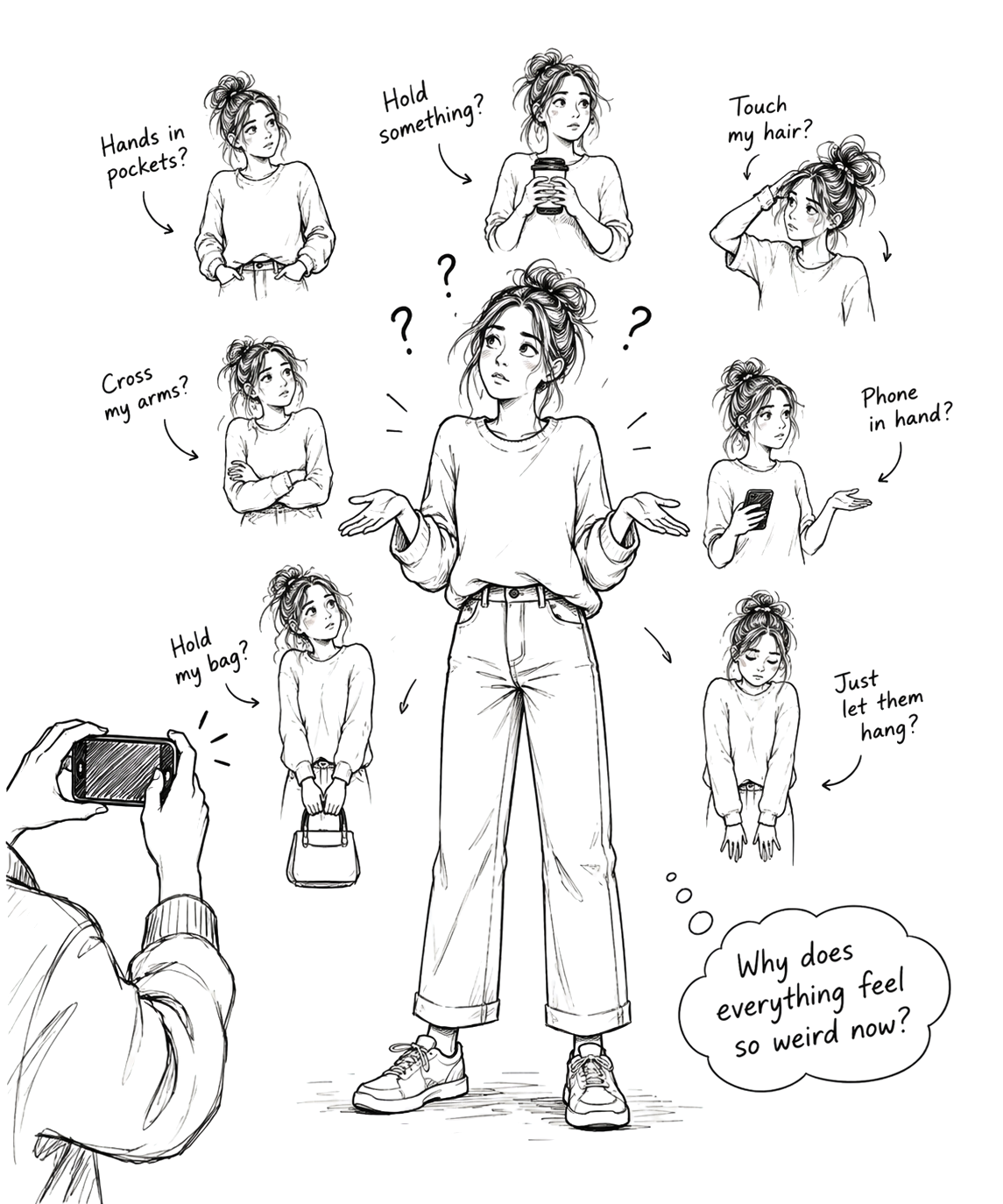
You aren't just smiling anymore. You're thinking about whether you're smiling correctly. You're not simply standing there. You're wondering whether you look like someone who is standing naturally. That's a much harder job.
The Camera Gives You a New Job
Before the camera appears, your attention is usually somewhere else. You're listening to a friend, looking at a menu, walking somewhere or thinking about what you're going to say next.
Once you know you're being photographed, you suddenly have another task: be aware of yourself.
That sounds harmless, but it can change the way you behave. Instead of experiencing the moment, you start managing how you appear in the moment.
You may start thinking, “Should I smile?” Then you notice your hands. Then your shoulders. Then you wonder where you're looking. By the time you've finished checking everything, the original moment has completely disappeared.
The camera didn't make you awkward. It simply gave you something new to monitor.
Why “Just Act Natural” Usually Doesn't Help
This is why “just act natural” is such an unhelpful instruction.
Natural behavior usually happens when you're not thinking about it. It's automatic. The second you're asked to produce it on purpose, you've already changed the situation.
Imagine someone telling you to walk naturally while you think about every step. You know perfectly well how to walk, but now you're paying attention to something that normally happens without any thought.
The same thing happens when someone tells you to look natural in a photo. You start checking whether you're being natural, which makes it much harder to actually relax.
You don't need to become unaware of the camera. You need to stop making your own behavior the thing you're concentrating on.
This Is Why “Smile” Can Make a Smile Worse
You've probably experienced this one.
You're already smiling because something is funny. Someone raises their phone and says, “Smile!”
And suddenly the smile you're already making disappears.
Now you're producing one.
The difference is small, but you can often see it in a photograph. The first smile came from something happening around you. The second came from an instruction.
Neither one is necessarily fake. They just come from different places. One is a reaction, while the other is a task.
That's also why photographs taken in the middle of a conversation, a walk or some ordinary activity can sometimes feel more alive. Your expression is responding to something instead of being created specifically for the camera.
A Camera Can Make You Feel Evaluated
There is another reason this happens.
A photograph doesn't disappear when the moment ends. Someone can look at it later. You can look at it later. Other people can see it too.
So even a completely casual photograph can suddenly feel like a tiny performance.
You start thinking about the result instead of the moment. Will I like this? Does my face look strange? Do I look different from how I normally look? Should I take another one?
The pressure doesn't have to be dramatic. Sometimes simply knowing that the photograph is going to exist is enough to make you monitor yourself more closely.
And once you start doing that, it's very easy to become less expressive without realizing it.
The Easiest Fix Is to Give Yourself Something Else to Think About
If cameras make you self-conscious, you don't necessarily need a better pose.
You may just need something else happening.
Walk somewhere. Look through a menu. Pick up your coffee. Talk to the person taking the picture. Look at something nearby. Fix your jacket because it actually needs fixing. Keep doing whatever you would normally be doing in that situation.
The point isn't to invent a fake activity so you can pretend the photograph is candid. It's to give your attention somewhere to go.
That's an important difference.
If you're standing still and thinking, “Do I look natural?”, your entire attention is pointed at yourself. If you're walking to the table while talking to someone, the camera is still there, but it isn't the only thing happening.
Your behavior has somewhere to come from.
You Don't Have to Forget About the Camera
There is no need to pretend you're secretly being photographed.
You can know exactly where the camera is. You can choose the light, choose your clothes, decide where you want to take the photo and even look directly at the camera.
All of that is completely normal.
The useful part is simply not allowing the camera to become the entire event.
A person can be aware of a camera and still be relaxed. The difference is what their attention is doing. If every thought is about their face, the photograph can become stiff. If they're also paying attention to the conversation, the place they're in, the drink they're holding or what they're doing next, the camera has less control over the moment.
You don't need to trick yourself into forgetting that you're being photographed. You just need to give yourself something more interesting to notice.
Give Yourself a Few Minutes
Another mistake is judging yourself too quickly.
You take one photo. You don't like it. You change your smile. Then you change your posture. Then you move your head. Then you take another photo to fix the previous one.
Soon you're no longer taking pictures. You're troubleshooting your face.
That's usually when things get harder.
Instead, take a small sequence without deciding whether each photo is good. Move around. Look in different directions. Continue whatever you're doing. Let a few moments pass before you start judging the results.
The first photograph may simply be the first photograph. It doesn't have to prove anything about how you look.
Sometimes you need a few minutes for the camera to stop feeling like an event.
Look at the Sequence, Not Just the First Frame
If you're trying to understand what kinds of photos actually suit you, look at several photographs together.
Notice when your expression starts changing. Notice when your shoulders relax. Notice what happens when you're looking away or talking. Pay attention to whether you seem more like yourself while you're moving than when you're standing still.
You may find a pattern you hadn't noticed before.
Maybe you don't actually hate being photographed. Maybe you hate the version of yourself that appears during the first thirty seconds, when you're still thinking about what you're supposed to do.
That's a very different problem.
And fortunately, it's a much easier one to work with.
Sometimes You Don't Need a Better Pose
This is probably the most useful thing to remember.
If you look perfectly normal until someone says, “Let me take a picture,” don't immediately conclude that you're bad at photos. Your face didn't suddenly stop working. You didn't forget how to stand. You didn't become less attractive in five seconds.
You became aware of yourself.
That awareness can change your expression, your posture and the way you move, especially when you're trying to control all three at once.
So the next time someone points a camera at you, try not to make “looking natural” your new job. Keep talking. Keep walking. Keep doing whatever you were already doing. Take a few photographs before deciding whether any of them are good.
The goal isn't to stop noticing the camera.
It's to make the camera less important than whatever was happening before it appeared.
Because sometimes the photograph you like most isn't the one where you finally figured out how to pose.
It's the one where, for a moment, you stopped thinking about how you looked and went back to being somewhere.