Everything is fine.
You're standing there. You're talking. Maybe you're holding a coffee. Maybe you're walking somewhere. Your hands seem to be doing their usual job.
Then someone takes out a camera.
Suddenly, you're aware of both of them.
Where are they supposed to go?
Should you put one in your pocket? Hold your phone? Touch your hair? Cross your arms?
And why does every option now feel strangely deliberate?
You can spend years using your hands without giving them much thought. Then someone points a camera at you and, somehow, they become the most important part of your body. There is a reason for that.
The camera gives you a new problem to think about
When you're having a normal conversation, you don't usually monitor what your hands are doing. They move when you talk. You hold things. You put them in your pockets. You adjust your sleeve. You touch your hair. Sometimes they just hang there.
None of this requires a plan.
A photograph changes the situation. Now there is a moment being captured, and you know someone will look at it later.
That small change can make you start monitoring yourself.
Instead of simply being in the moment, you start watching yourself being in the moment.
And once that happens, your hands suddenly become noticeable.
Very noticeable.
This is why "just relax your hands" is terrible advice
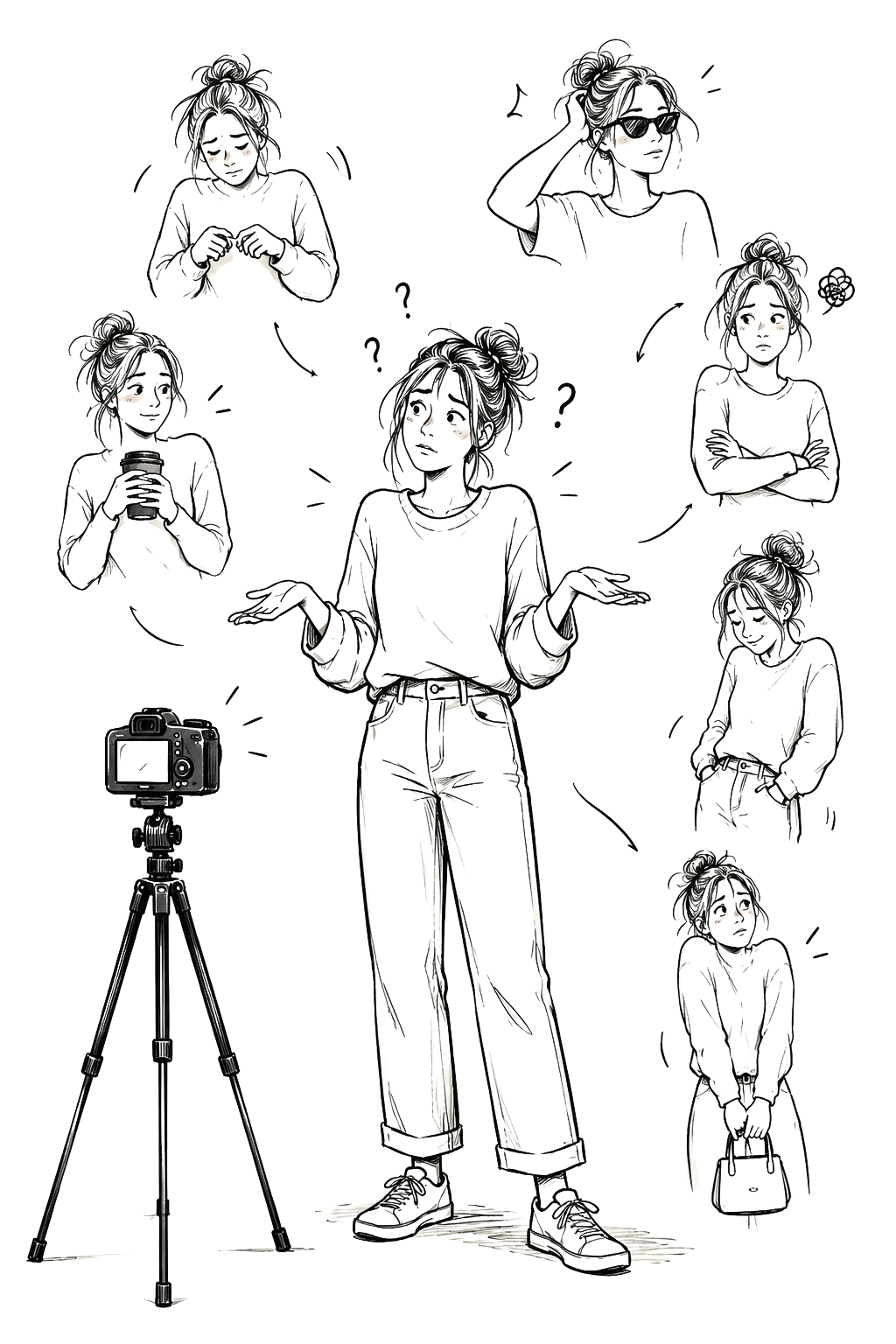
It's one of those instructions that sounds helpful until you actually try it.
"Just relax."
Okay.
How?
Now you're thinking about relaxing. And because you're thinking about your hands, they don't feel relaxed anymore.
This is similar to being told to walk naturally while someone watches you walk.
You probably know how to walk. You have been doing it for quite a while.
But now that you're thinking about every step, something that normally happens automatically starts feeling like a task.
The same thing happens with your hands. The problem isn't that you don't know what to do with them. The problem is that you're suddenly trying to supervise something that normally takes care of itself.
Your hands aren't supposed to perform
This is where a lot of photo advice gets unnecessarily complicated.
There are endless suggestions for what to do with your hands. Put one hand on your hip. Touch your hair. Hold your jacket. Touch your face. Put your hand in your pocket.
And none of these things are inherently bad.
They can work perfectly well.
The strange part is when you start doing them because you've been given an assignment rather than because they make sense in the moment.
Then the hand stops being part of the scene.
It becomes a prop.
You can usually see the difference.
One person is holding a coffee because she's drinking coffee. Another person is holding a coffee because someone told her she needed something to do with her hands.
Same coffee.
Very different photograph.
Give your hands a reason to exist
This is one reason real activities can make photographs feel so much easier.
If you're walking, your hands have somewhere to go. If you're carrying a bag, there is a reason you're holding it. If you're opening a door, your hand is doing something.
None of this requires a special pose.
The situation does the work for you.
And that can make a surprisingly big difference.
You're no longer thinking:
What should I do with my hands?
You're thinking:
Where am I going?
Or:
What was I about to say?
Or:
Why is this door apparently much harder to open than it looks?
That last one might actually make for a better photograph than another carefully rehearsed hand position.
There is another reason posed hands can look strange
A photograph freezes something that normally moves.
This matters more than we sometimes realize.
When you're talking, walking or reaching for something, your hands are part of a continuous movement. A photograph captures one tiny fraction of it.
That means a perfectly normal movement can look slightly strange when frozen at the wrong moment.
Your hand might be halfway through a gesture. Your fingers might be moving. Your arm might be between two positions.
In real life, nobody cares.
The movement continues.
In a photograph, that single frame suddenly becomes the entire story.
This is one reason taking several photos can help. You're not trying to discover the one magical position your hands are supposed to occupy. You're simply giving yourself more moments to work with.
The best hand position might be no position at all
This sounds obvious, but it's surprisingly difficult to remember when you're being photographed.
Your hands don't need to look interesting. They don't need to create a pose. They don't even need to be visible in some cases.
They just need to make sense with what you're doing.
That's a much easier standard.
A hand in a pocket can work. Holding a drink can work. Adjusting a bag can work. Touching your hair can work.
And yes, simply letting your arms hang naturally can work too.
The goal isn't to make your hands photographically impressive.
Nobody is scrolling through a dating profile thinking, "Excellent hand placement."
They are looking at the person.
This is why candid photos can feel easier
A candid-looking photograph often works partly because nobody appears to be managing every part of their body at once.
There is a little movement. A little asymmetry. Something is happening.
The person isn't necessarily trying to demonstrate the perfect pose.
They're doing something.
That gives the photograph a reason to exist.
And it gives the person in it something else to think about besides the camera.
This is especially useful when you're already uncomfortable being photographed.
You don't need another thing to get right.
You need fewer things to think about.
So what should you actually do?
The slightly annoying answer is: don't start with your hands.
Start with what you're doing.
If you're outside, walk. If you're having coffee, actually have the coffee. If you're looking around, look around. If you're talking, talk.
If you're fixing your hair because it's actually in your face, fix it.
The photograph can happen around the action.
That's very different from inventing an action for the photograph.
And if someone tells you, "Just do something with your hands," you now have permission to ask the obvious question:
Why?
Maybe your hands were perfectly happy before anyone started taking pictures.
Your hands were never the problem
The funny thing is that your hands probably haven't changed at all.
They worked perfectly well five minutes ago. They knew where to go when you opened your phone, picked up your coffee, pushed open a door or adjusted your jacket.
The camera didn't suddenly make them awkward.
It just made you notice them.
And once you stop treating your hands like two separate photographic problems that need solving, they can go back to doing what they were already doing.
Which is probably the best thing they could do.
After all, you're trying to take a photograph of a person.
Not conduct an interview with their hands.